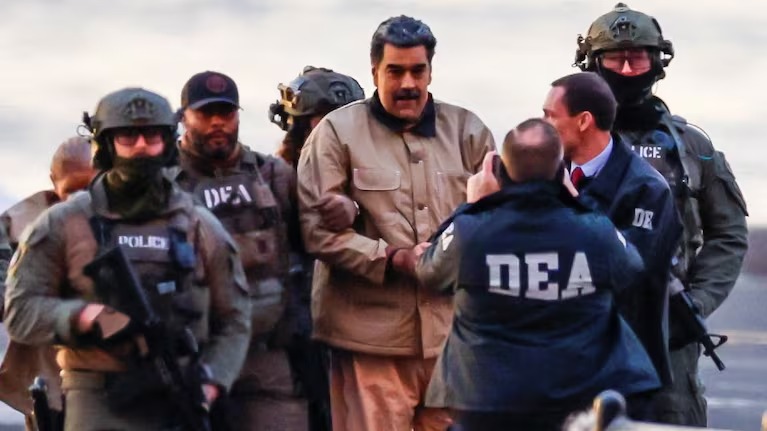
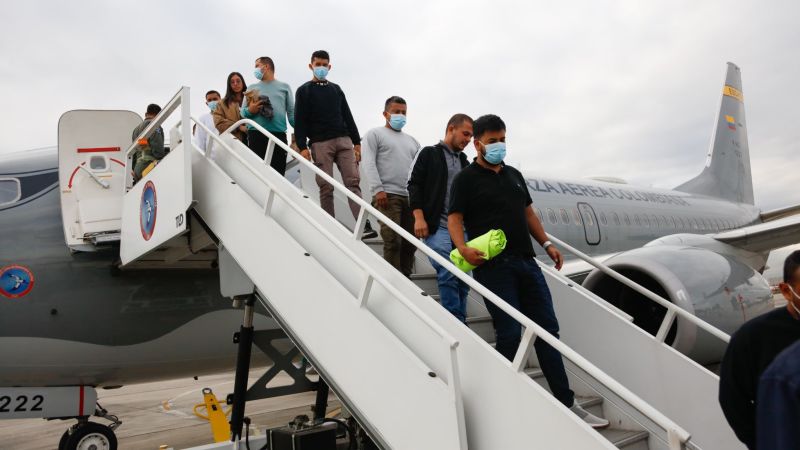
Colombia and the United States went through moments of intense diplomatic tensions in 2025. Following various measures implemented in US foreign policy under the government of Donald Trump, which included mass detentions and deportations of immigrants –who according to the president represented criminals and undocumented individuals– the imposition of tariffs, and adding the capture of former Venezuelan leader Nicolás Maduro —under a military operation deployed in Caracas on January 3, 2026—, the Colombian president was quick to oppose these policies.
From then on, both presidents clung to their positions, and through posts on their social media they demonstrated the foundations of what set them apart.
On one hand, Trump made it clear that US immigration policy adhered to the principles outlined by the Monroe Doctrine, "America for the Americans," where he drastically prioritizes a specific population (Americans) over immigrants residing in the United States and even over other countries. This also includes sharp trade decisions indicating that Trump intends to change the rules of the game driven by national interest. Other statements by the president promote the war on drugs, which led Trump to declare war on Nicolás Maduro, accusing him of being the leader of drug trafficking in Venezuela and of an alleged "Cartel de los Soles." What has caused the most uproar in public opinion, and especially for President Gustavo Petro, are the methods used to implement these policies, which according to several analysts would be having negative repercussions both domestically and internationally.
Petro also responded strongly to Trump's imposition of tariffs, taking equivalent measures. And finally questioning the manner in which the United States intruded into Venezuelan territory, but above all rejecting the threats to the sovereignty and freedom of Colombia and its citizens.
How did two opposites end up in the Oval Office?
The threats that Donald Trump has launched at countries like Mexico, Cuba, and Colombia led Petro to take a defensive stance, which triggered a series of mutual disqualifications where it seemed that at some point the situation would explode between both countries.
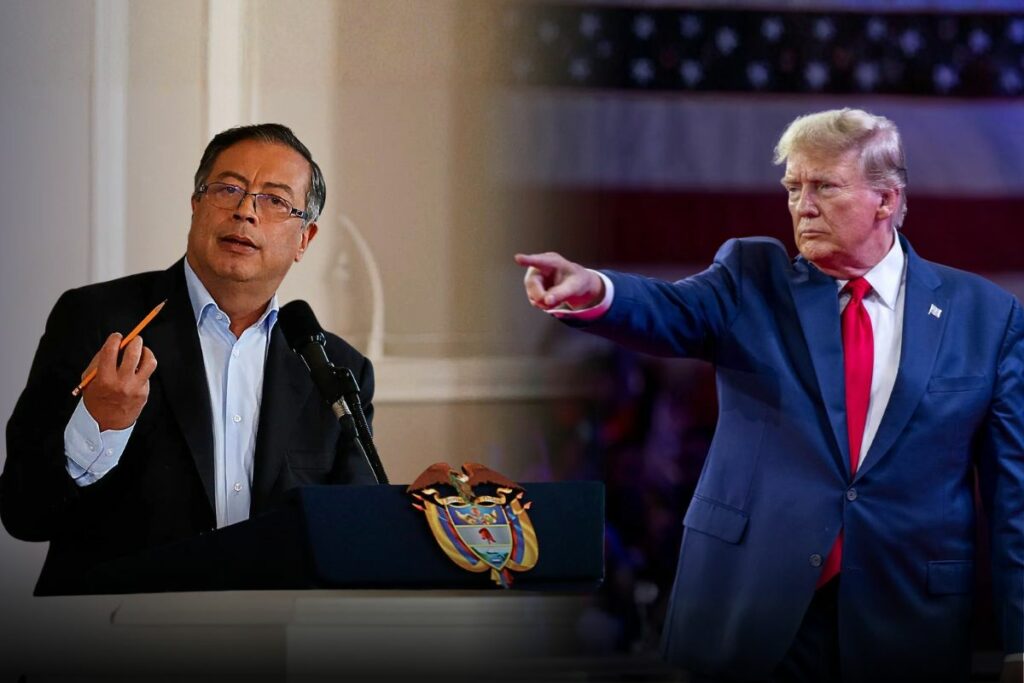
The landscape took a drastic turn on January 7 of this year, when in different cities across Colombia a demonstration was deployed, called by the president to protect and defend the sovereignty and freedom of Colombia against these threats. In the speech delivered by Petro that same day, he informed the citizens that he had had a call with Trump hours earlier, during which they held a peaceful conversation that concluded with Trump's personal invitation to Petro to attend the White House in Washington D.C. to arrange a meeting between both leaders and diplomatically resolve the generated tensions. Previously, Donald Trump had revoked the Colombian president's visa, so the meeting was made possible by granting him a temporary visa.
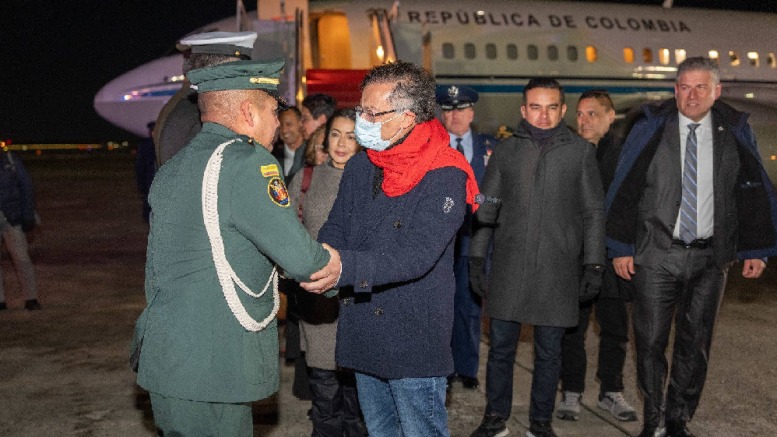
Thus, on February 3, Gustavo Petro and his delegates traveled aboard an official US Secret Service vehicle which bore a Colombian flag and finally arrived in Washington. However, as official sources report, he was not personally received by President Trump nor by the traditional military guard, as was the case with Javier Milei, President of Argentina, and Nayib Bukele, President of El Salvador. Although it may seem like an almost imperceptible detail, this reflects that political and ideological affinities characterize the North American leader's agenda, sending an implicit message to other countries in the region regarding American preponderance in the power that has been maintained for centuries over South American countries.
The meeting between the counterparts took place behind closed doors –in the Oval Office–, meaning it was a private meeting with no press access, no public broadcast, and no presence of third parties outside the official delegations. What is known about the meeting was transmitted directly through official communications or subsequent statements from each government.
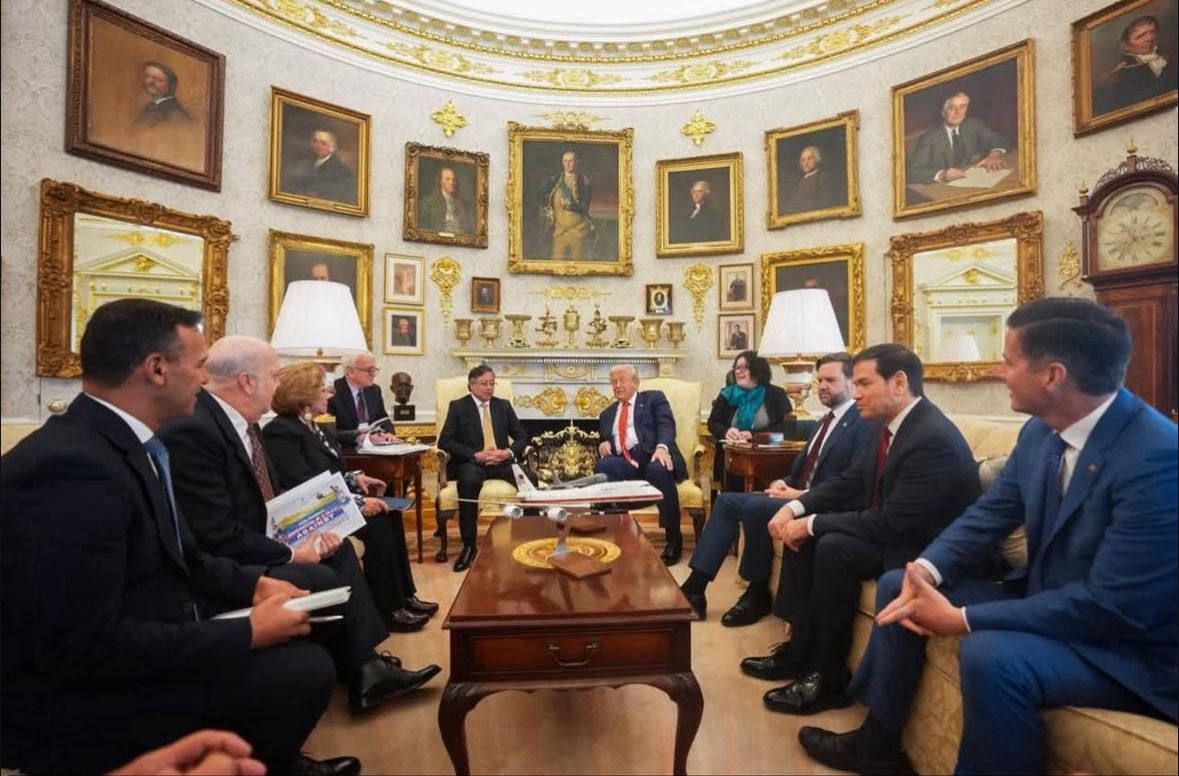
The delegations were composed on Trump's side by the Secretary of State, Marco Rubio, the Vice President, JD Vance, and the Republican senator of Colombian origin, Bernie Moreno. On the other hand, Petro attended with Foreign Minister Rosa Villavicencio, the Minister of Defense, Pedro Sánchez Suárez, the Ambassador to the United States, Daniel García Peña, and finally the Director of Illicit Crop Substitution, Gloria Miranda. With all present, the meeting began.
Subsequent official communications indicated a satisfactory meeting where both parties were able to take advantage of the space to give an opportunity to dialogue that had previously been made impossible by the preponderance of ego on both sides. This meeting prioritized discussing drug trafficking in detail and what the best path to combat it would be. In addition to words, the leaders exchanged gifts that included photos and personal messages from each.
Conclusion
Ultimately, this is a meeting that left public opinion perplexed, and it is understandable after the escalation that the relationship between the leaders experienced in 2025, when Trump revoked the visa of Gustavo Petro, added him and his family to the so-called "Clinton List", and furthermore withdrew Colombia's certification as a country cooperating in the fight against drugs. And as if that weren't enough, he accused the Colombian president of being a drug trafficking leader in Colombia, as he did with Nicolás Maduro.
So how is it that these two people ended up in dialogue at the White House?
The strategic presence in both leaders' agendas is evident. On one hand, Donald Trump understood that the plan he had assembled to intervene in Venezuela was not going to work in the same way in a country like Colombia, which despite internal conflicts, meets the standards of a democratic and sovereign territory, where its president was elected with 11,281,013 votes equaling 50.44% against 47.31% for Rodolfo Hernández Suárez. Gustavo Petro has the support of a considerable portion of the Colombian citizenry, which makes it not so simple for Trump to deploy his power. Furthermore, the track record and actions of Petro's government demonstrate a general commitment to fulfilling its proposals and responsibility in the fight against drug trafficking, which is Trump's main excuse for intervening in Latin America and the Caribbean.
As for Petro's strategy, one can analyze a president who accepts that fighting drug trafficking will require economic support, with intelligence cooperation, military and police assistance, among others. But above all because the enmity between Washington and Bogotá only benefits the Colombian right wing, which has taken advantage of the frictions between both presidents to wage a dirty campaign and call for illegitimate interventions and captures against Petro.
It is worth remembering that politics constitutes an inevitable space of plurality and confrontation of visions, in which actors with divergent and, in many cases, openly opposed ideologies converge. However, precisely in that scenario, dialogue stands as a fundamental means for building minimum consensuses oriented toward the well-being of peoples. As President Gustavo Petro stated in one of his posts on X announcing his agenda in Washington, he is "willing to continue strengthening the relationship between two nations that share the same objective: the fight against drug trafficking, from an approach that prioritizes life and peace in our territories." Societies can hardly sustain themselves on leaderships that privilege individual ends to the detriment of regional stability and relations between neighboring countries, since this type of strategy tends, sooner or later, to erode through its own contradictions. In this sense, despite the controversial nature of the meeting —also marked by the accusations facing Donald Trump in relation to the Epstein files—, the meeting acquires a relevant symbolic value by reopening channels of dialogue and projecting a signal of hope for diplomacy between two peoples that have maintained an evident unequal relationship and treatment regarding the handling of power.
Bibliography
- Al Jazeera - "Colombia backs down on deportation flights after Trump's tariff threats" - Coverage of Petro's refusal to accept deportees on military planes and Trump's tariff threats. https://www.aljazeera.com/news/2025/1/26/trump-threatens-sanctions-as-colombias-petro-blocks-us-deportation-flights
- The Washington Post - "Trump deported 200 Colombians. None were criminals, officials say." - Report on deported Colombian citizens. https://www.washingtonpost.com/world/2025/01/28/colombia-migrants-trump-petro/
- CNN - "The US has captured Venezuelan leader Maduro. Here's what to know" - Coverage of Operation Absolute Resolve on January 3, 2026. https://edition.cnn.com/2026/01/03/americas/venezuela-explosions-intl-hnk
- PBS NewsHour - "U.S. revokes visa for Colombian President Petro" - On Petro's visa revocation in September 2025. https://www.pbs.org/newshour/world/u-s-revokes-visa-for-colombian-president-petro-after-he-urges-american-soldiers-to-disobey-trump
- Infobae - "Gustavo Petro fue incluido en la Lista Clinton" - Details on OFAC's inclusion of Petro and his family on the Clinton List. https://www.infobae.com/colombia/2025/10/24/gustavo-petro-fue-incluido-en-la-lista-clinton-razones-implicaciones-y-reacciones-a-la-sancion/
- NPR - "For the first time in decades, U.S. says Colombia is falling short in the drug war" - On Colombia's decertification. https://www.npr.org/2025/09/16/nx-s1-5543055/colombia-drugs-u-s-trump-petro
- U.S. Department of State - Official statement on Colombia's decertification in counternarcotics efforts. https://www.state.gov/releases/office-of-the-spokesperson/2025/10/u-s-decision-not-to-certify-colombias-counternarcotics-efforts-and-sanctions-actions-against-colombian-officials-involved-in-global-illicit-drug-trade
- NBC News - "Trump calls Colombia's Petro an 'illegal drug leader'" - Trump's statements accusing Petro of leading drug trafficking. https://www.nbcnews.com/politics/trump-administration/trump-colombian-president-end-us-aid-rcna238437
- France 24 - "Concluye reunión de Gustavo Petro y Donald Trump en la Casa Blanca tras un año de tensiones" - Coverage of the February 3, 2026 meeting. https://www.france24.com/es/ee-uu-y-canad%C3%A1/20260203-trump-y-petro-llegan-a-una-cita-clave-en-la-casa-blanca-tras-un-a%C3%B1o-de-fricciones
- Al Jazeera - "Trump-Petro updates: US, Colombia leaders meet at White House amid tensions" - Live coverage of the bilateral meeting. https://www.aljazeera.com/news/liveblog/2026/2/3/live-trump-petro-to-meet-at-the-white-house-after-months-of-tensions
- NBC News - "'Icebreaker': Frantic diplomacy set up last-minute call between Trump and Colombia's Petro" - Diplomatic details of the preceding phone call. https://www.nbcnews.com/world/south-america/frantic-diplomacy-set-call-trump-colombias-petro-rcna253142
- Foreign Policy - "Trump Meets Colombia's Petro in Closely Watched White House Meeting" - Geopolitical analysis of the meeting. https://foreignpolicy.com/2026/02/03/trump-petro-meeting-colombia-drug-trafficking-cocaine-maduro/
- Foreign Policy - "What Trump's New Corollary to the Monroe Doctrine Means for Latin America" - Analysis of the Monroe Doctrine in Trump's foreign policy. https://foreignpolicy.com/2025/12/08/monroe-doctrine-trump-corollary-national-security-strategy-venezuela/
- El País (Cali) - "Marchas convocadas por el Gobierno Petro este 7 de enero" - Coverage of the sovereignty demonstrations. https://www.elpais.com.co/colombia/marchas-convocadas-por-el-gobierno-petro-en-vivo-conozca-todos-los-detalles-de-la-jornada-este-7-de-enero-del-2026-0643.html
- NPR - "An uneasy detente: Trump and Colombia's Petro meet at White House" - Analysis of the contrast in Petro's reception vs. Milei and Bukele. https://www.npr.org/2026/02/02/nx-s1-5693039/petro-trump-colombia-white-house